Spokane WA Heat Pump Installation is a heat pump contractor working across Spokane County, WA and out to Post Falls, Idaho. This guide is written for homeowners and builders dealing with the same conditions we design for every day.
Late summer smoke has become a routine feature of Spokane's year rather than an occasional event. The instinctive response is to buy a better filter, and that instinct is right in principle and frequently wrong in execution. A denser filter dropped into a system with no static pressure headroom starves the blower and makes things worse. This guide covers what actually works, in what order, and why the measurement has to come before the purchase.
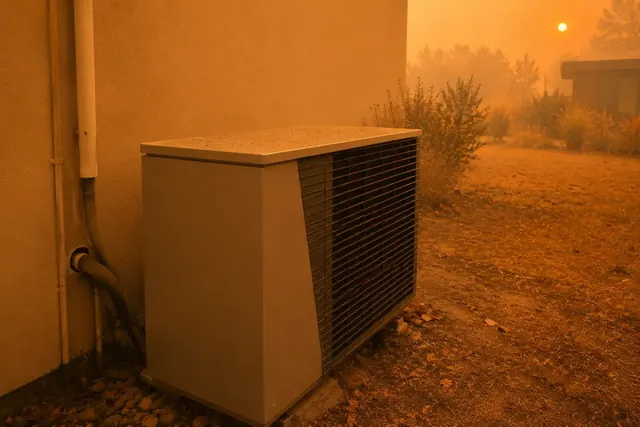
The same weeks that bring smoke indoors also deposit fine ash across your outdoor coil. Filtration protects the inside of the house, and an autumn service visit protects the equipment. They are two halves of the same seasonal problem.
PM2.5 refers to particulate matter with a diameter of 2.5 microns or smaller. For scale, a human hair is roughly 70 microns across. Particles this small stay suspended in air for long periods, travel enormous distances, and are small enough to penetrate deep into the respiratory system rather than being filtered out by the nose and throat.
Wildfire smoke is predominantly PM2.5, which is why it is both so visible as haze and so difficult to exclude from a building. Ordinary infiltration through a building envelope carries it indoors, and standard furnace filters do essentially nothing to capture it. During a significant smoke event, indoor particulate levels in an unprepared house track outdoor levels closely.
MERV stands for Minimum Efficiency Reporting Value and it rates a filter's ability to capture particles in specified size ranges. Higher numbers capture smaller particles more effectively. The ratings that matter in a residential context are these.
| Rating | Typical capture | Practical use |
|---|---|---|
| MERV 1-4 | Large particles, lint, dust | Equipment protection only, no air quality benefit |
| MERV 5-8 | Mould spores, dust mite debris | Common builder default, minimal fine particulate capture |
| MERV 9-12 | Fine dust, some fine particulate | Improvement, still limited on smoke |
| MERV 13 | Fine particulate including much PM2.5 | The practical minimum for smoke |
| MERV 14-16 | Higher fine particulate capture | Requires system designed for the resistance |
MERV-13 is the generally accepted practical minimum for meaningful wildfire smoke filtration in a residential system. It captures a substantial share of PM2.5 while remaining achievable in a properly designed residential air handler. Higher ratings capture more and impose considerably more resistance.
This is the part that gets skipped, and it is the reason so many filtration upgrades make systems worse. Every filter imposes resistance to airflow, measured as a pressure drop. A denser filter imposes more. The blower in your air handler has a finite capacity to overcome resistance, expressed as its rated performance against external static pressure.
A typical system is designed with a total external static pressure budget of around 0.5 inches of water column, and that budget has to cover the ductwork, the coil, the registers and the filter together. If the existing ductwork is already consuming most of it, there is no headroom left for a denser filter. Adding one anyway reduces airflow, which produces a cascade of consequences.
The single most useful thing you can do before upgrading filtration is have total external static pressure measured on your system. It costs very little, it takes minutes, and it tells you definitively whether you have the headroom for a denser filter or whether you need a different approach. Any contractor selling you a MERV-13 filter without that measurement is guessing with your equipment.
The correct approach is almost always to increase filter area rather than filter density in the same footprint. A four inch deep media filter has vastly more surface area than a one inch filter of the same face dimensions, which means it can achieve MERV-13 capture at a considerably lower pressure drop.
A four inch media cabinet is a physical modification requiring space at the air handler, which is why it needs planning rather than being a filter you buy at the hardware store. Where the space genuinely does not exist, portable air cleaners in the rooms that matter most are a legitimate and often overlooked answer.
Modern tight homes need mechanical ventilation, and in Climate Zone 5 homes above 1,500 square feet are required to have heat recovery or energy recovery ventilation. During a smoke event that ventilation system is bringing outdoor air into the house, which is precisely the air you are trying to keep out.
This does not mean switching ventilation off indefinitely. A tight house with no ventilation accumulates carbon dioxide, humidity and indoor pollutants, and the smoke event can last weeks. The correct approach is filtration on the outdoor air intake, so the ventilation system continues to work while the incoming air is cleaned.
While you are managing indoor air quality, the outdoor unit is drawing that same smoky air across its coil continuously. Fine ash deposits on and between the coil fins and acts as an insulating layer across the heat exchange surface, which reduces capacity exactly during the hot weather that typically accompanies smoke events.
This is the specific reason we recommend an autumn service visit in this area rather than a single annual one. Spring pollen loads the coil at one end of the season and late summer ash loads it at the other, and a coil cleaned in April is not clean by October. Rinsing the coil from the inside outwards, so debris exits the way it entered rather than being driven deeper into the fins, is what actually restores capacity.
None of this is a substitute for a system that was designed with filtration in mind. If you are replacing equipment anyway, specifying the filter cabinet at that point costs a fraction of retrofitting one later, and it means the static pressure budget accounts for MERV-13 from the start rather than being compromised by it afterwards.
If you want this applied to your own house rather than read in general, call and we will come and measure it.
Request a quote