Spokane WA Heat Pump Installation is a heat pump contractor providing packaged heat pump systems for homeowners and property owners across Spokane County, WA and out to the Idaho state line. Every job starts from a load calculation rather than the size of whatever came out.
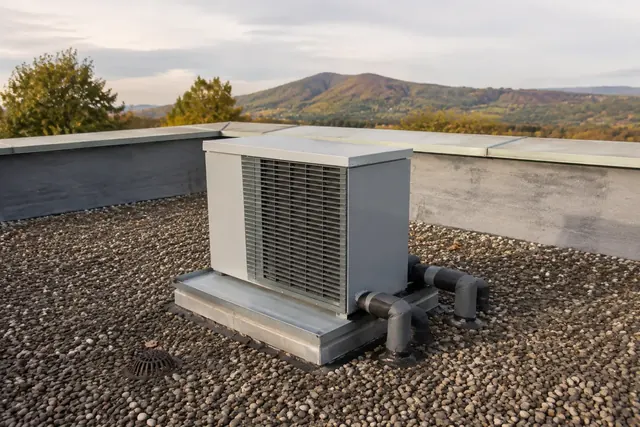
A packaged heat pump puts the compressor, both coils and the blower into one outdoor cabinet, with only ductwork crossing into the building. That suits two situations particularly well: manufactured homes, where there is no mechanical room and the ducts run under the floor, and small commercial buildings where roof mounting keeps equipment out of usable interior space. There is no indoor unit and no field-brazed refrigerant line set, which removes a whole category of installation faults. What it adds is a cabinet sitting fully exposed to Spokane weather year round.
Because the cabinet sits outside, the duct connections between it and the building are exposed. On a 0°F Spokane morning, an unsealed or poorly insulated duct boot loses conditioned air straight to outdoors, which is why the duct connection detail matters more on packaged units than anywhere else.
Packaged units simplify the refrigerant side and shift the risk onto the duct and mounting details.
The duct connection at the cabinet is where packaged systems most often lose their efficiency. Supply and return boots pass through outdoor air, and if those connections are only taped rather than sealed and insulated properly they leak conditioned air directly outside. On manufactured homes this joins an existing issue, since underfloor duct systems in older units are frequently in poor condition. We inspect that ductwork before quoting because replacing the equipment without addressing it produces a disappointing result.
Set the new packaged unit on the existing curb or pad, reconnect the duct boots with tape and call the job finished.
Inspect the existing duct condition first, seal and insulate the boots properly, and tell you upfront if the underfloor or rooftop duct system needs work to make the new equipment worthwhile.
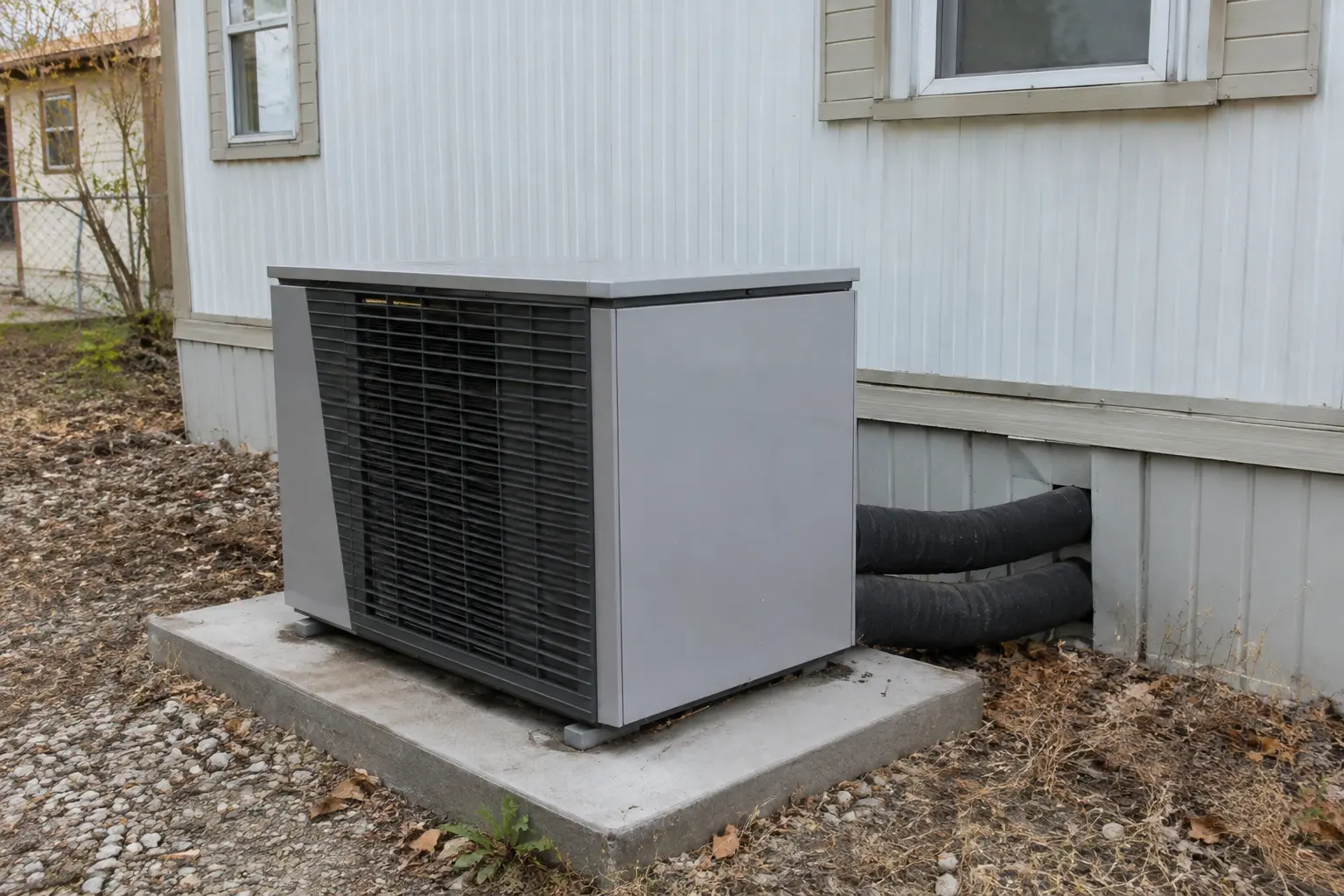
Packaged equipment is sized from the same Manual J load calculation as any other system, but the duct evaluation carries more weight because the ducts are a larger share of the total loss. On manufactured homes in particular, the underfloor duct system is often the single biggest opportunity for improvement, and it makes little sense to install correctly sized equipment onto a duct system that is losing a substantial fraction of its airflow.
For rooftop applications the additional constraint is the curb. A replacement unit either matches the existing curb footprint or needs an adapter, and the adapter changes the airflow path slightly. We confirm curb dimensions before ordering rather than discovering the mismatch on the day the crane is booked.
Packaged equipment cost tracks capacity and efficiency tier much like any other system. Installation cost is dominated by mounting and duct connection work rather than by refrigerant piping, which is factory sealed.
The variables that move a packaged quote most are curb compatibility on rooftop replacements and the condition of existing ductwork on manufactured homes. We check both before quoting, because both have the potential to change the scope substantially.
We measure the existing curb or pad, check duct connections and assess service access at the actual location.
A Manual J sets the capacity, and the existing duct system is evaluated because on packaged installs it is a large share of total loss.
The unit is set on its curb or pad, duct boots are connected, sealed and insulated, and electrical and condensate are completed.
Airflow and temperature split are verified in both modes, and the duct connections are checked for leakage at the cabinet.
Packaged work is either on a roof or at ground level beside the building, and each has its own access requirements.
Packaged units draw outdoor air through their cabinet all summer, which matters in late August. Our wildfire smoke and filtration guide covers PM2.5 loading, filter selection and what actually helps during a smoke event. Read the guide.
Call for a load calculation and an itemised quote. You keep the numbers either way.
Request a quote