Spokane WA Heat Pump Installation is a heat pump contractor providing heat pump removal and disposal for homeowners and property owners across Spokane County, WA and out to the Idaho state line. Every job starts from a load calculation rather than the size of whatever came out.
Removing a heat pump is not simply disconnecting it and carrying it away, because the refrigerant inside is a controlled substance under federal law. It has to be recovered into a certified recovery cylinder using a recovery machine, weighed and sent for reclamation. Venting it to atmosphere is illegal and carries substantial penalties. Beyond the refrigerant, the equipment contains steel, copper and aluminium that all have genuine recycling value, plus an oil charge that needs proper handling. Most removals take a few hours.
Refrigerant recovery slows considerably in cold weather because the pressure differential the recovery machine relies on is smaller. A winter removal needs more time allowed for it than the same job in July, which is worth knowing if you are scheduling around other trades.
Removal is the job most likely to be done badly because nobody inspects it afterwards and the customer cannot see what was skipped.
Where a heat pump is being removed and not replaced, the leftover infrastructure needs dealing with properly too. An abandoned disconnect box with live conductors, an open line set penetration in the wall and an unsupported condensate line are all things we see left behind after a removal. We make the electrical safe, seal the wall penetration and remove or cap the redundant condensate route, and that work is part of the job rather than an extra.
Cut the line set, carry the unit away and leave the disconnect, wall penetration and condensate line for someone else to deal with.
Recover the refrigerant properly, isolate and make the electrical safe, seal the wall penetration and remove the redundant infrastructure as part of the same visit.
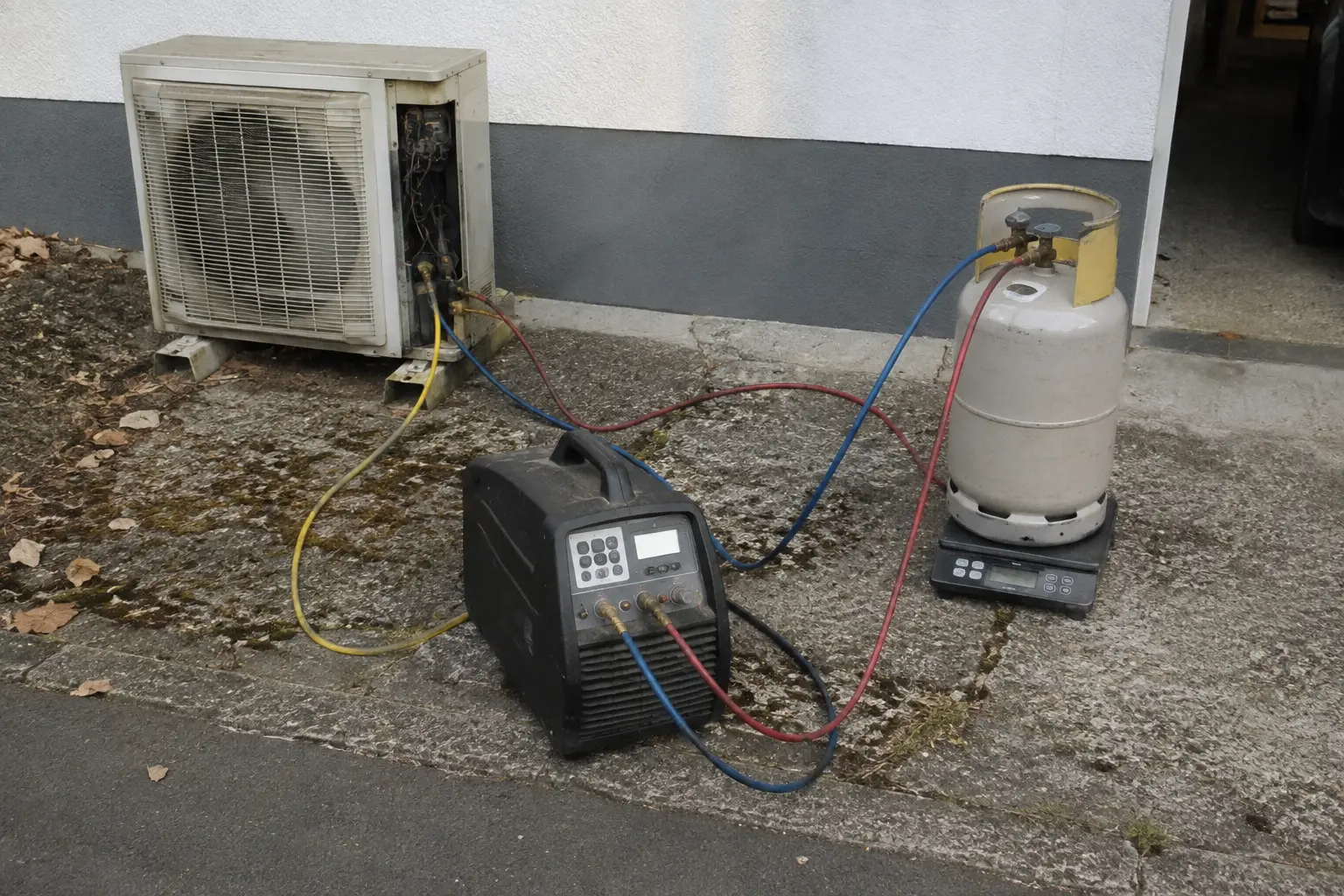
A recovery machine draws refrigerant out of the system and pushes it into a recovery cylinder, which sits on a scale so the recovered quantity can be weighed and recorded. Cylinders have a fill limit that must not be exceeded, which is one of the reasons the scale is not optional.
Recovery speed depends on ambient temperature and on the physical state of the refrigerant. Liquid recovery is much faster than vapour recovery, which is why a technician will typically pull liquid first where the system allows it. In cold weather the whole process slows down because the available pressure differential is smaller, so a January removal simply takes longer than the same job in summer.
Standalone removal is priced on the size of the equipment, the difficulty of getting it out, and whether the pad and infrastructure are being removed as well. When removal is part of a replacement it is included in that job rather than charged separately.
Recovered metals have scrap value, which is factored into the price rather than kept quiet. Where a removal produces a significant amount of recoverable copper, that is reflected in what you pay.
The electrical supply is isolated and the refrigerant is recovered into a weighed cylinder using a recovery machine.
Line set, electrical connections and condensate are disconnected, and the equipment is prepared for removal.
Indoor and outdoor sections are taken out along a pre-agreed route and loaded, with the pad removed as well if requested.
Wall penetrations are sealed, redundant electrical is isolated and labelled, and the metals are separated for recycling.
Removal is mostly a logistics job, so the clearer the route out, the faster it goes.
What comes out of an old system matters as much as what goes in. Our A2L refrigerant guide explains the phase-down of R-410A, why reclamation is becoming more important, and what the new refrigerants change about handling. Read the guide.
Call for a load calculation and an itemised quote. You keep the numbers either way.
Request a quote