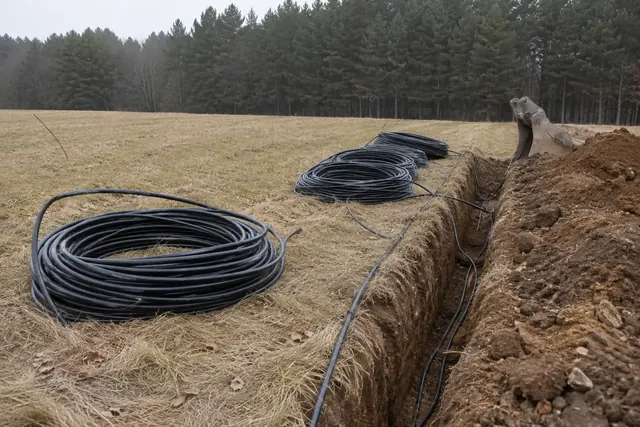
Horizontal geothermal ground loop trench with HDPE pipe on a rural Spokane County acreage
Spokane, WA

Geothermal Heat Pumps in Spokane, WA | Ground Loop Design and Trenching for Rural Acreage

Spokane WA Heat Pump Installation is a heat pump contractor providing geothermal heat pumps for homeowners and property owners across Spokane County, WA and out to the Idaho state line. Every job starts from a load calculation rather than the size of whatever came out.

A ground source heat pump exchanges heat with the earth rather than the outdoor air, and in a climate like Spokane's that difference is the entire point. Ten to fifteen feet below the surface, ground temperature holds between 50°F and 55°F year round while the air above it swings from below zero to a hundred. Because the equipment is always working against a mild source, coefficient of performance typically averages above 3.0, meaning three units of heat delivered for every unit of electricity consumed. These are land-intensive projects, which is why they suit the acreages around Deer Park, Elk and Chattaroy rather than a valley subdivision lot.

Request a quote

Tell us what you need and we will call you back.

Ground loop source temperature versus winter air
-20°17°32°47°65°85°100°
50-55°F ground

The reason geothermal outperforms air source in a cold climate sits in one number. While the air is at 0°F, the loop is drawing from ground that never leaves the low fifties, so the compressor never faces the extreme lift that limits air source capacity.

50-55°FGround temperature at 10 to 15 feet, year round
3.0+Typical coefficient of performance
Below frostLoop depth dictated by the local frost line
Geothermal Heat Pumps Spokane

Spokane WA Geothermal Heat Pumps

What actually matters on a geothermal system

Geothermal has the longest life and the highest upfront cost of anything in this trade. The decisions that matter most are made before the trencher arrives.

  • Horizontal loop trenching taken below the local seasonal frost line, not to a standard depth
  • Soil thermal conductivity assessed before loop length is finalised
  • Loop pressure tested and purged of air before the system is charged
  • Flow centre and manifold accessible for future service, not buried behind finished walls

Loop design is where geothermal projects succeed or fail, and it is site specific in a way that catalogue equipment is not. The gravel-heavy ground common across parts of the Spokane aquifer region conducts heat differently from dense clay, and a loop sized for the wrong conductivity will pull the ground temperature down over a season until performance degrades. We assess the ground before finalising loop length rather than applying a standard figure per ton.

The usual approach

Trench a standard loop length per ton of capacity, backfill and hope the ground behaves like the design software assumed.

How we do it

Assess the actual soil and rock conditions on the site first, then size the loop for that ground, because a loop that is too short cannot be lengthened after backfilling.
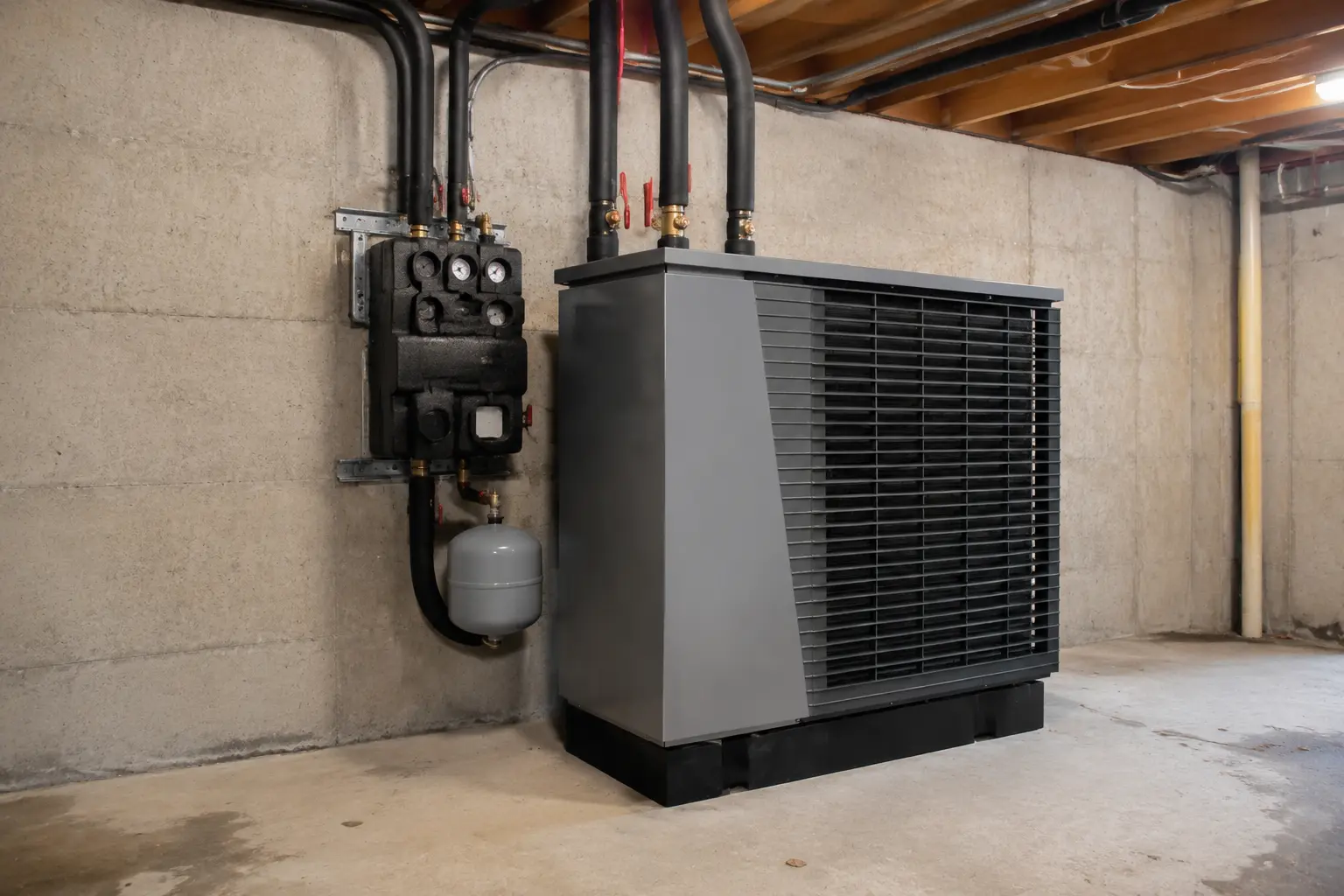
Water to air geothermal heat pump unit and flow centre in a rural basement

At a glance

Ground temperature
50°F to 55°F at 10 to 15 ft
Typical COP
Above 3.0
Loop type
Horizontal slinky or vertical bore
Trench depth
Below local seasonal frost line
Detail

Sizing and equipment selection for a geothermal system

Ground source equipment is selected against entering water temperature rather than outdoor air temperature, which changes the whole selection process. The performance tables are read at the minimum entering water temperature the loop is expected to reach at the end of a Spokane heating season, not at a nominal rating condition.

Loop length follows from that. A shorter loop costs less to install but allows the ground around it to cool further over the season, which lowers entering water temperature and pushes the equipment towards its capacity limit exactly when demand peaks. We size for end-of-season conditions, which is the expensive answer and the correct one.

What separates a good job from an average one

  • Available land decides loop type. Horizontal slinky loops need substantial open ground, while vertical bores fit a small site at considerably higher drilling cost.
  • The loop is effectively permanent. Equipment inside the house gets replaced eventually, but a correctly installed loop outlasts several generations of it.
  • Antifreeze selection matters in this climate, since the loop fluid can sit below freezing at the end of a long heating season.
  • Utilities, septic fields and well lines all have to be located before trenching, and on rural acreages the records are frequently incomplete.
  • Flow rate through the loop is verified at commissioning, because a loop that is not purged of air will never deliver its design performance.

What drives the cost of a geothermal installation

50-55°FLoop source temperature
3.0+Coefficient of performance
Site specificLoop length, set by soil conductivity

Geothermal cost is dominated by the ground loop, not the equipment. Horizontal trenching on open ground is the least expensive loop option and needs the most land. Vertical boring suits constrained sites and costs substantially more per ton because it involves a drilling rig.

This is a long-horizon investment rather than a like-for-like replacement decision. The operating cost advantage over air source is real and compounds over decades, but the payback arithmetic only works when you intend to stay. We will say so plainly if your situation does not suit it.

How it runs

What happens, in order

Step 01

Site assessment

We walk the property, locate the well, septic and buried services, and assess available land and ground conditions for loop type.

Step 02

Loop design

Soil conditions and the building load together set loop length and configuration, whether horizontal slinky or vertical bore.

Step 03

Excavation and loop

Trenches are cut below the frost line, HDPE loop is laid and fused, then pressure tested before any backfill goes in.

Step 04

Flow centre and commission

The indoor unit, manifold and flow centre are installed, the loop is purged and charged, and flow rate and entering water temperature are verified.

Before we arrive to install a geothermal loop

Geothermal is the most disruptive install in this trade because it involves excavation across your property. Preparation genuinely shortens the project.

  1. Have your well and septic locations marked, including the drain field extent, since these determine where trenching cannot go.
  2. Call for a utility locate well ahead of the start date, and tell us about any private buried lines to outbuildings that a public locate will not find.
  3. Identify any trees you want protected, because root systems extend considerably further than the canopy suggests.
  4. Clear the trench route of vehicles, equipment, woodpiles and fencing that would obstruct an excavator.
  5. Plan for the ground surface to be disturbed for a full season. Reseeding usually happens the following spring rather than immediately.

Frequently asked questions

How much land do I need for a geothermal system?
Enough for a horizontal loop field, which is why this suits acreage rather than subdivision lots. If the land is not there, a vertical bore field fits a much smaller footprint at significantly higher drilling cost. We assess your specific property before quoting either.
How deep do the trenches have to go?
Below the local seasonal frost line, which is what dictates the depth rather than a fixed number. Around Spokane the first hard ground frost typically arrives in early October and the last spring frost extends into late May, and the loop has to sit below the depth that freezing reaches.
Is geothermal worth it compared to an air source heat pump?
It depends entirely on how long you intend to stay. Operating efficiency is genuinely better because the loop draws from ground in the low fifties instead of air near zero, but the upfront excavation cost is substantial. Over a few years the arithmetic does not work. Over decades it usually does.
Do I need to be present while you install a geothermal loop?
At the start, yes, because we need to walk the trench route with you and confirm well, septic and buried service locations together. The excavation itself runs for several days and does not need you standing over it.
Do you offer free quotes for geothermal heat pumps?
Yes, and a geothermal quote takes longer than most because it includes a site assessment for loop type and ground conditions. That assessment is worth having even if you decide against the project.
What happens to my yard?
It gets torn up, and there is no version of this where it does not. Trenches are backfilled and the surface is restored, but the ground stays visibly disturbed for a season and most people reseed the following spring. We would rather you know that clearly at the quote stage.

Geothermal Heat Pumps in Spokane

Phone
509-352-6630
Quote
Free, includes the load calculation measurements
Typical duration
Below local seasonal frost line
Service area
Spokane County, WA and Post Falls, ID

Geothermal Heat Pumps in Spokane, WA

Call for a load calculation and an itemised quote. You keep the numbers either way.

Request a quote

509-352-6630