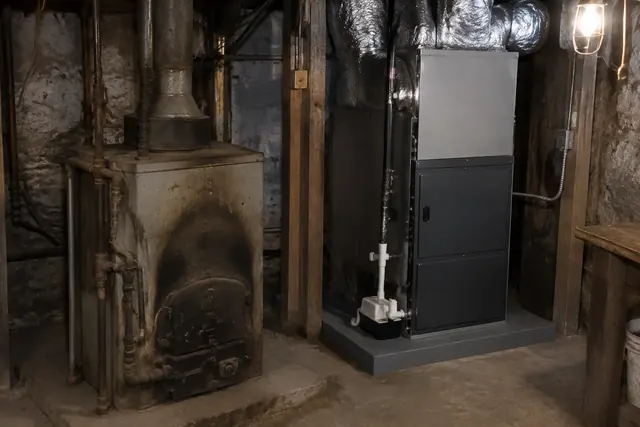
Spokane WA Heat Pump Installation is a heat pump contractor providing oil-to-heat-pump conversion for homeowners and property owners across Spokane County, WA and out to the Idaho state line. Every job starts from a load calculation rather than the size of whatever came out.
Oil heating persists on older rural properties around Spokane County where natural gas was never run, and converting away from it is usually a full replacement rather than a dual fuel arrangement. Oil prices are volatile, delivery is a logistical commitment through winter, and the equipment tends to be old. The conversion involves removing or decommissioning the oil furnace, dealing with the tank, and confirming the electrical service can support a heat pump, which on older rural properties is frequently the item that dictates the project scope.
Unlike a gas dual fuel arrangement with a changeover point, oil conversions usually remove the fuel entirely. The heat pump carries the full season, which makes cold climate specification and correctly sized backup heat more important than in a dual fuel job.
Oil conversions are the largest scope change of any conversion type, because the properties involved are usually the oldest.
Buried oil tanks are the complication that changes an oil conversion from straightforward to complicated. An abandoned underground tank has environmental implications and its removal or in-place decommissioning is specialist work that sits outside HVAC. We flag it clearly at the assessment stage and point you to the right people rather than working around it, because it is not something to discover after the heating has been replaced.
Remove the oil furnace, install the heat pump and leave the tank and the electrical service capacity as somebody else's problem.
Assess the electrical service first, identify what has to happen with the tank, and give you the whole picture including the parts that are not our work.
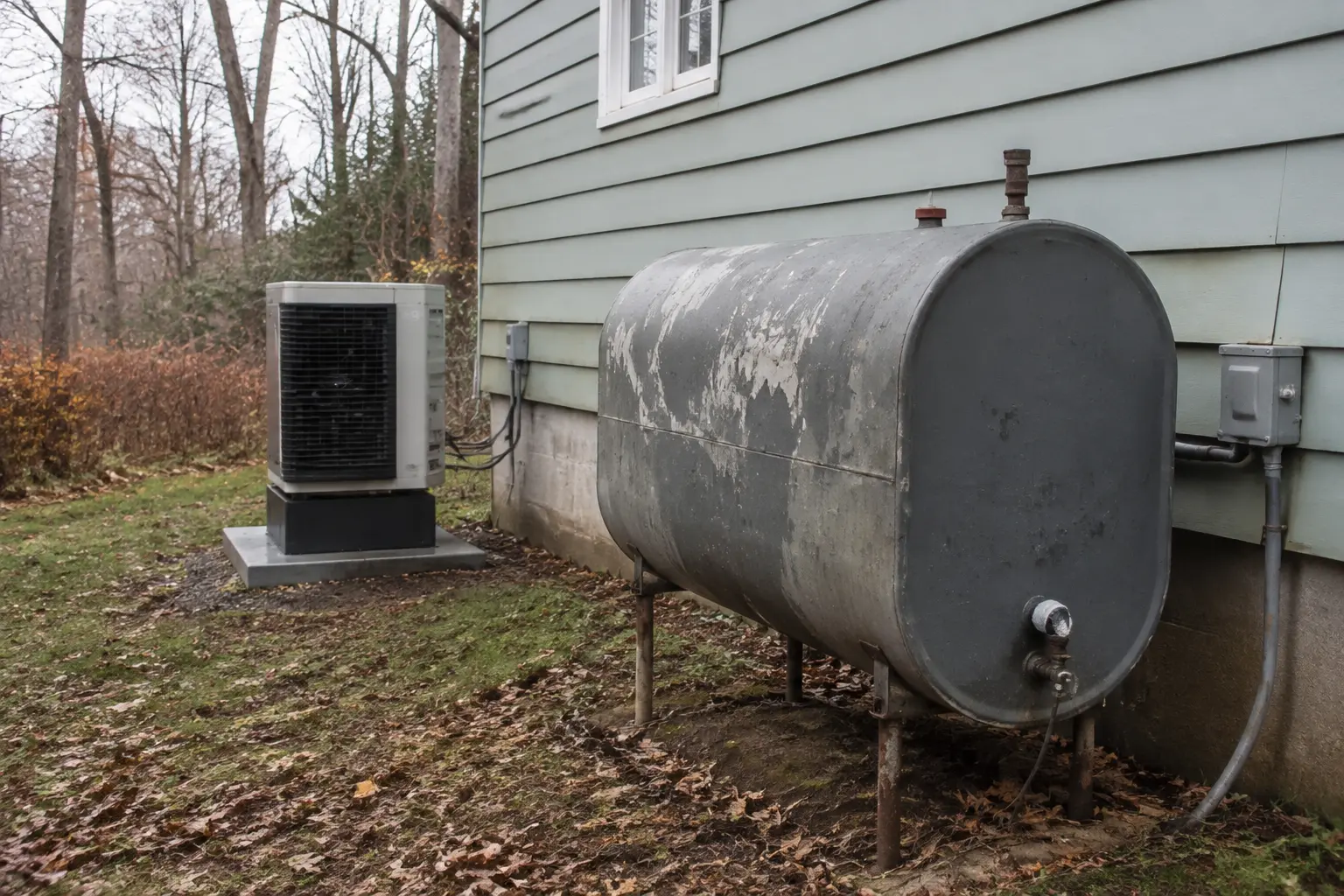
Because the oil appliance is being removed rather than retained, the heat pump has to carry the entire heating load at Spokane's winter design condition. That pushes the specification firmly towards cold climate equipment with published capacity data well below zero, rather than standard equipment relying on a fossil fuel partner for the cold end of the season.
Distribution is the other decision. Where the property has ductwork from a forced air oil furnace, a ducted heat pump follows naturally. Where the oil appliance was a boiler feeding hydronic baseboard there is no duct system at all, and the realistic options become ductless heads, an air to water heat pump, or installing ductwork as part of the project. Each carries a very different cost, and we set them out side by side.
Oil conversion cost is dominated by two items outside the heat pump itself: electrical service capacity and, where there is no ductwork, the distribution system. Either can exceed the equipment cost on an older rural property.
Tank decommissioning is a separate specialist cost that we do not carry out, and we would rather you had that number in front of you at the planning stage than discovered it later. We will tell you what to expect and who to speak to.
We check the electrical service capacity, the existing distribution system and the oil tank situation before discussing equipment.
Where there is no ductwork, the realistic distribution options are priced side by side rather than presented as one answer.
The oil appliance is removed, the heat pump system is installed, and any electrical capacity work is completed.
Heating operation is verified at low ambient, backup heat is configured, and you are shown how the system behaves through a season.
Oil conversions need more information gathered upfront than any other job we do, because the property's infrastructure sets the scope.
Call for a load calculation and an itemised quote. You keep the numbers either way.
Request a quote