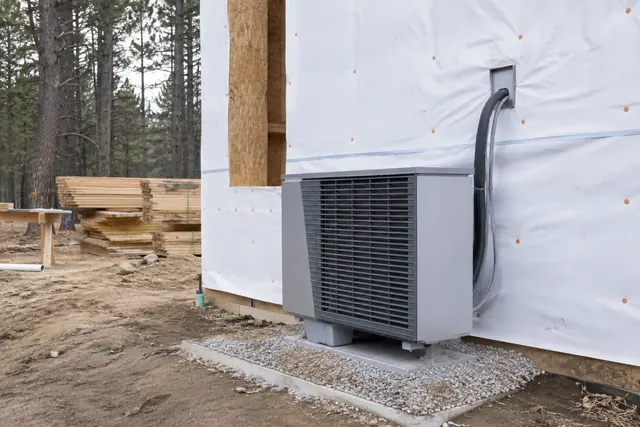
Spokane WA Heat Pump Installation is a heat pump contractor working across Spokane County, WA and out to Post Falls, Idaho. This guide is written for homeowners and builders dealing with the same conditions we design for every day.
There is a widespread belief that Washington mandates heat pumps in new homes. That is not quite right, and the difference matters if you are planning a build. The explicit heat pump requirement was removed from the final 2021 Washington State Energy Code. What remains is the R406 energy credit structure, which does not name heat pumps as mandatory but makes them the most economical route to compliance for most homes. This guide sets out what the code actually says.
The explicit heat pump mandate was struck from the final 2021 WSEC. The credit structure that replaced it produces a similar practical outcome by economics rather than by requirement, and stating that accurately matters.
During the development of the 2021 Washington State Energy Code, provisions were proposed that would have effectively required heat pumps for space heating and water heating in new residential construction. Those explicit requirements were removed from the final adopted code following legal and industry challenge.
What survived is the energy credit structure in Section R406, which requires new homes to accumulate a minimum number of credits from a table of efficiency measures. Heat pumps are not named as mandatory anywhere in that structure. They simply happen to be the cheapest way for most builders to reach the required credit total, which produces a similar outcome through economics rather than through requirement.
This distinction is not pedantic. If a contractor tells you the code requires a heat pump, they are describing the situation inaccurately, and it is worth knowing whether that is carelessness or a sales technique. The honest position is that the credit arithmetic makes heat pumps very difficult to avoid economically, which is a different statement.
Section R406 of the residential energy code sets out a table of efficiency measures, each carrying a credit value. A new home must accumulate at least the minimum total for its size. Builders are free to reach that total however they choose, and there are usually several viable routes.
Because the routes are interchangeable, the credit system is genuinely a whole-building decision rather than a mechanical one. A builder might choose a higher efficiency heat pump and reduce the envelope specification slightly, or the reverse. That trade-off is worth modelling at design stage rather than discovering at inspection.
| Dwelling size | Credits required |
|---|---|
| Under 1,500 sq ft | 5.0 |
| 1,500 to 5,000 sq ft | 8.0 |
| Over 5,000 sq ft | Higher, per the code table |
| Additions under 500 sq ft | Reduced requirement per the code |
The middle band covers the large majority of new homes built in the Spokane area. Eight credits is a meaningful requirement that cannot be met by any single measure alone, which is why the compliance route is always a combination.
An efficient electric heat pump for space heating contributes a substantial share of the required credits, and an efficient heat pump water heater adds further credits on top. A split system heat pump water heater can contribute up to 2.5 credits on its own, which is a large fraction of an eight credit requirement from a single appliance.
That combination, a heat pump for space heating plus a heat pump water heater, is the most economical route to compliance for most homes in this area. It is not the only route, and where a builder has a strong reason to prefer a different approach the arithmetic can be worked through. But it explains why heat pumps dominate new construction in Washington without being mandated by name.
Because the credit values interact with the envelope specification, the mechanical decision should be made at design stage rather than after framing. A higher efficiency heat pump may earn enough credits to allow a modest reduction elsewhere, and that trade-off has real cost implications across the whole build.
This is the practical reason we ask to see plans before permit rather than being called once the framing is up. By the time the building is standing, most of the flexibility in the credit route has already been spent.
Separately from the credit structure, homes in Climate Zone 5 above 1,500 square feet require heat recovery or energy recovery ventilation. This is a requirement rather than a credit option, and it exists because modern air sealing standards produce buildings that do not supply fresh air by accident.
An energy recovery ventilator exchanges heat, and to a degree moisture, between the outgoing stale air and the incoming fresh air, which recovers most of the energy that simple exhaust ventilation would throw away. In Spokane there is a second argument for it that the code does not address: an ERV is the point at which outdoor air enters the house, which makes it the right place to filter during wildfire smoke season.
The commercial provisions of the Washington State Energy Code operate separately from the residential ones and have moved firmly towards heat pump systems. Requirements include provisions around heat pump service water heating in commercial structures, and the practical effect is that heat pump systems are the straightforward compliance route for most new commercial work.
Commercial compliance is more prescriptive and more heavily documented than residential, and the requirements are best addressed at design stage rather than at inspection. We work from drawings on commercial projects for exactly that reason.
This guide describes the general structure of the residential energy credit system as we understand it. Code editions change and local jurisdictions administer them, so the requirements applicable to your specific permit should be confirmed with your building department. We do that as part of any new construction project we work on.
If you want this applied to your own house rather than read in general, call and we will come and measure it.
Request a quote