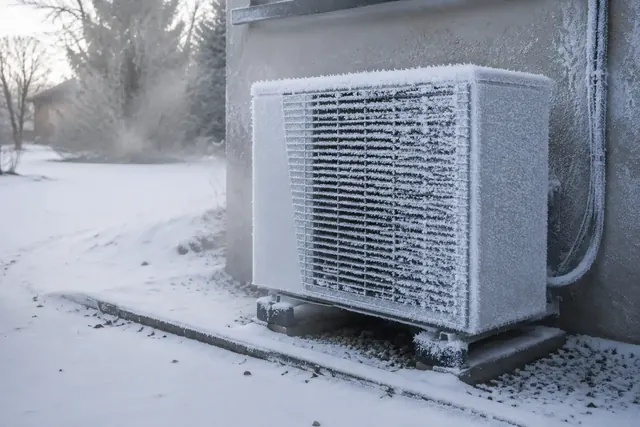
Spokane WA Heat Pump Installation is a heat pump contractor working across Spokane County, WA and out to Post Falls, Idaho. This guide is written for homeowners and builders dealing with the same conditions we design for every day.
Almost every heat pump problem we are called out to trace back to a sizing decision made before the equipment was ordered. This guide sets out the climate data Spokane sits in, the design conditions we calculate against, and why the difference between a nominal tonnage and a published low-temperature capacity figure is the single most important thing to understand when comparing quotes.
Manufacturers publish headline heating capacity at 47°F. Spokane's winter design condition sits far below that. Everything in this guide is about closing the gap between those two numbers.
Spokane sits in ASHRAE Climate Zone 5B, which is the cold and dry designation. Under the Köppen classification the area is Dsb, a warm-summer humid continental climate with dry summers. In practical terms that means a genuinely cold winter, a hot and very dry summer, and a large annual temperature swing that equipment has to handle in both directions.
The figures that matter for equipment selection are the extremes rather than the averages. Spokane sees extreme winter minimums in the range of 0°F to 5°F in most years, with between 125 and 150 frost days annually. The first hard ground frost typically arrives in early October and the last spring frost extends into late May, which is why the growing season here is short and why ground loop trenching depth is dictated by that frost penetration rather than by a standard figure.
| Parameter | Value | Why it matters |
|---|---|---|
| ASHRAE climate zone | 5B, cold and dry | Sets the code requirements and the design assumptions |
| Köppen classification | Dsb | Warm summer humid continental with dry summers |
| Extreme winter minimums | 0°F to 5°F in most years | The condition equipment must still perform at |
| Frost days per year | 125 to 150 | Drives defrost cycle frequency across the season |
| USDA hardiness zone | 7a | Commonly quoted locally as a proxy for winter severity |
| Ground temperature at depth | 50°F to 55°F | The source temperature a geothermal loop draws from |
Heating degree days measure how much heating a location needs across a year. The figure is calculated by taking a base temperature, conventionally 65°F, and adding up how far below it the average daily temperature falls, day by day, across the year. A day averaging 45°F contributes twenty degree days. A day averaging 65°F contributes none.
The Spokane area accumulates roughly 4,000 to 5,500 heating degree days annually depending on elevation and exact location within the region. That is a substantial heating season, and it is why heating rather than cooling is the governing case for equipment selection in almost every house here. A system sized only against the summer cooling load will be undersized for winter, which is the opposite of the situation in most of the southern United States.
Cooling degree days in Spokane are comparatively modest despite genuinely hot summer afternoons, because the dry climate produces large overnight temperature drops. The practical consequence is that a system sized to carry the winter heating load is frequently larger than the summer cooling load alone would require, which is one of the strongest arguments for variable-speed equipment that can turn down.
ACCA Manual J is the standardised method for calculating a building's heat loss and heat gain. It works room by room, using the actual construction of the house rather than its floor area, and produces a result in BTU per hour. The inputs are the ones you would expect and a few that people routinely underestimate.
The output is not a single number but a set of them: a whole-house heating load, a whole-house cooling load, and a room by room breakdown that also produces the airflow each room requires. That airflow figure is what duct design under Manual D is built from, which is why the calculation has to come before any decision about equipment or ductwork.
Manual J tells you what the house needs. Manual S is the process of choosing equipment that delivers it, and it is the step most commonly skipped. The reason it matters so much in Spokane is that a heat pump's capacity is not a fixed number. It varies with outdoor temperature, and it varies differently between models that carry identical nameplate ratings.
Published heating capacity is measured at an AHRI rating point of 47°F outdoor temperature. Spokane's winter design condition is far below that. What Manual S requires is reading the manufacturer's expanded performance data, which tabulates capacity and power draw across a grid of outdoor temperatures, and confirming the equipment still delivers what the house needs at the design condition rather than at the rating point.
Two units with the same nominal tonnage and the same headline efficiency can differ by thirty percent or more in the capacity they still produce at 5°F. That difference is invisible on a quote that lists only the model number and the nominal size, and it is the difference between a system that carries your house through a cold snap and one that hands the job to resistance heat.
This is why we put the low-temperature capacity figure on our quotes. If you are comparing proposals from several contractors, that number is the one worth asking for, and a contractor who cannot produce it has not done the selection properly.
The balance point is the outdoor temperature at which the heat pump's output exactly equals the building's heat loss. Above it, the heat pump carries the house alone. Below it, the shortfall has to be made up by supplementary heat, whether that is electric resistance strips or a fuel-burning furnace in a dual fuel arrangement.
There are actually two balance points and confusing them causes real problems. The thermal balance point is the physics question just described. The economic balance point, which applies only to dual fuel systems, is the temperature at which running the heat pump costs the same per unit of heat as running the furnace. The economic balance point is usually the higher of the two, and it is the one that should set the changeover on a dual fuel system. In this area it commonly lands between 25°F and 30°F, though it moves with utility rates.
Oversized equipment is the most common problem we find in existing Spokane homes, and it arises from a reasonable instinct applied badly. A contractor rounds up to be safe, then rounds up again for the coldest imaginable day, and the result is a system with far more capacity than the house needs on all but a handful of days a year.
Correct sizing produces a system that runs longer at lower output. That is more comfortable, more efficient and easier on the equipment, and it is why a properly calculated replacement is frequently smaller than the system it replaces.
If you are holding several quotes and they all list a tonnage and a price, you do not yet have enough information to compare them. These are the questions that separate a specified system from a guessed one.
None of these questions are unreasonable and none of them require you to understand the answers in technical detail. What matters is whether the contractor can produce them at all. The ones who have done the work will have the numbers to hand.
If you want this applied to your own house rather than read in general, call and we will come and measure it.
Request a quote