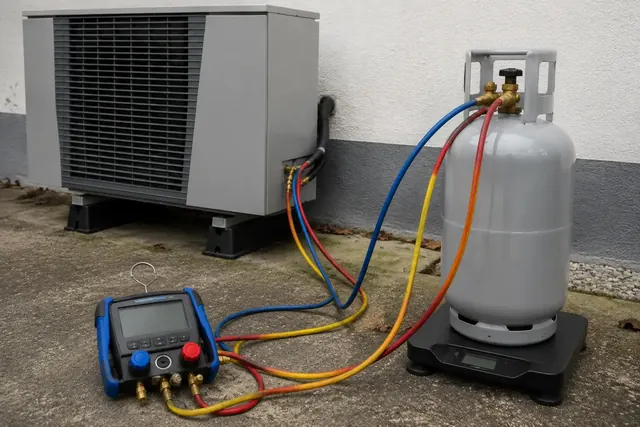
Spokane WA Heat Pump Installation is a heat pump contractor providing heat pump refrigerant recharge for homeowners and property owners across Spokane County, WA and out to the Idaho state line. Every job starts from a load calculation rather than the size of whatever came out.
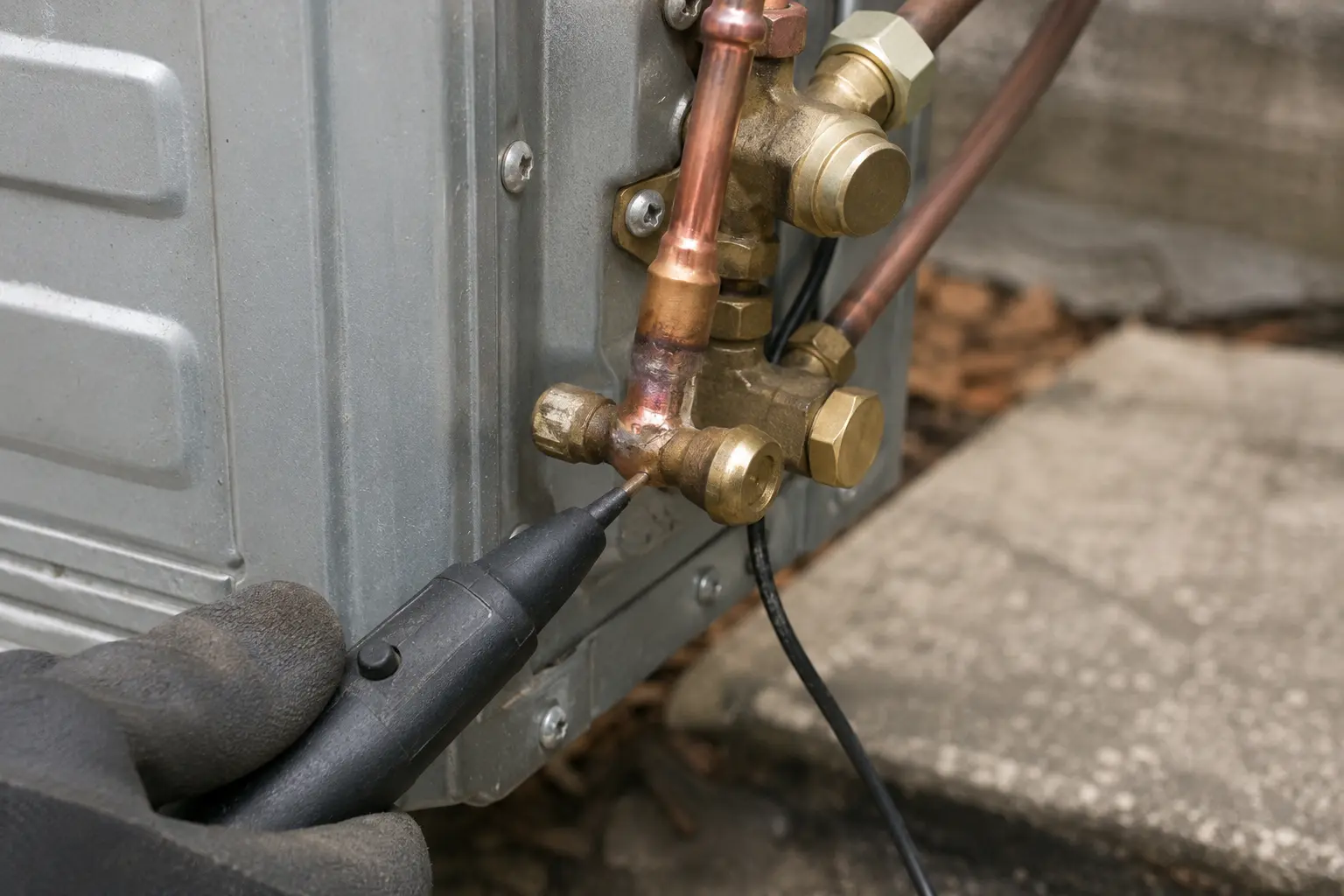
A refrigerant circuit is sealed, so it does not consume refrigerant the way an engine consumes oil. If a system is low, refrigerant has escaped, and adding more without finding out where from means paying for the same visit again next season. We locate the leak first using electronic detection and, where needed, ultraviolet dye, then tell you what repairing it involves. Where the repair is economic we do it and recharge by weight. Where it is not, we say so plainly rather than selling you an annual top-up habit.
A slightly undercharged heat pump often performs acceptably in mild weather and fails to keep up once outdoor temperature falls into the twenties, because the reduced charge leaves no capacity margin exactly when the load peaks.
Refrigerant work is where corner cutting is easiest to hide, because the customer sees a working system either way.
The most common leak locations we find are the outdoor coil, the service valve stems, brazed joints at the equipment and, on ductless systems, the flare connections at the indoor head. Coil leaks are the awkward ones, because a leaking coil often costs enough to replace that on an older system it pushes the decision towards replacing the equipment entirely. We give you that comparison rather than quietly recharging and letting you discover it a year later.
Connect the gauges, add refrigerant until the pressures look right, and book the customer in again next year when it happens once more.
Find where the refrigerant went, price the repair against the alternatives, and only then recharge by weight with the result verified against target.
The manufacturer specifies a charge weight for the equipment plus an adjustment per foot of line set beyond the factory allowance. Where the system can be evacuated and recharged from empty, weighing in that exact figure is the most accurate method available and removes all guesswork.
Where a full recovery is not practical, the charge is trimmed using superheat on a fixed orifice system or subcooling on a system with a thermostatic or electronic expansion valve, compared against the manufacturer's target for the measured indoor wet bulb and outdoor dry bulb conditions. Both approaches produce a defensible number. Reading pressure and judging by experience does not.
The visit cost is leak detection plus the repair plus the refrigerant itself. Refrigerant prices vary considerably by type, and older refrigerants being phased down have become notably more expensive, which affects the economics on older systems.
That refrigerant cost is exactly why we find the leak first. Repeatedly buying refrigerant to replace what is escaping through a known leak is the most expensive way to run a heat pump, and it is a pattern we would rather break than participate in.
Pressures and superheat or subcooling are measured to distinguish an undercharge from a restriction or an airflow problem.
Electronic detection is used across the coil, valves, joints and flare connections, with ultraviolet dye where the leak is elusive.
You get the repair cost, and where relevant the comparison against replacing the equipment, before anything else happens.
The leak is repaired, the system is evacuated and the charge is weighed in, then verified against the manufacturer's target.
Leak detection is the bulk of the visit, and it needs the system accessible at every point refrigerant travels.
Refrigerant availability and cost are changing quickly. Our A2L refrigerant guide explains the phase-down of R-410A, what R-454B and R-32 mean for servicing, and how this affects the repair or replace decision on an older system. Read the guide.
Call for a load calculation and an itemised quote. You keep the numbers either way.
Request a quote